
Table of Contents
- Professional Dog Training Near Me: How to Find the Right Trainer
- Step 1: Define Your Dog’s Training Needs and Behavior Goals
- Step 2: Compare Dog Training Methods and Humane Handling
- Step 3: Check Dog Trainer Certification and Experience
- Step 4: Compare Training Options: Private Dog Training, Classes, and Board and Train
- Step 5: Understand Pricing, Packages, and Program Duration
- Step 6: What to Expect Before, During, and After Training
- Step 7: Questions to Ask and Warning Signs to Avoid
- Frequently Asked Questions
Last Updated: October 16, 2026
Professional Dog Training Near Me: How to Find the Right Trainer
Searching for professional dog training near me returns a crowded list of providers, and most owners pick the first name that appears. That shortcut often leads to mismatched methods, wasted money, and a dog that never quite learns.
The stakes are higher than most owners realize. A trainer who relies on fear or pain can create lasting anxiety, while a trainer who never sets boundaries produces a dog that ignores every cue.
Step 1: Define Your Dog’s Training Needs and Behavior Goals
Start by writing down what you actually want your dog to do. Vague goals like “behave better” make it impossible to judge whether a trainer succeeded.
Your dog’s age shapes the plan. Puppies under six months need socialization and foundation work before problem behaviors take root. Adult dogs, especially rescues, often need behavior modification for reactivity, fear, or aggression. A trainer who handles puppy classes may not be equipped for a dog with a bite history.
Match the trainer’s specialty to your dog’s age and behavior profile. A generalist who runs group puppy classes is rarely the right fit for an adult dog with reactivity issues.
Puppy Foundations vs. Adult Dog Behavior Issues
Puppy training focuses on prevention. Early structure teaches boundaries, builds focus, and creates positive habits before unwanted patterns set in. For dogs six months and older, the work shifts toward correcting established behaviors like jumping on people, nipping, excessive barking, and poor impulse control.
Step 2: Compare Dog Training Methods and Humane Handling
Ask every trainer to describe their methods before you book. The answer tells you more about fit than any review. Training approaches fall along a spectrum, and you need to know where a provider sits.
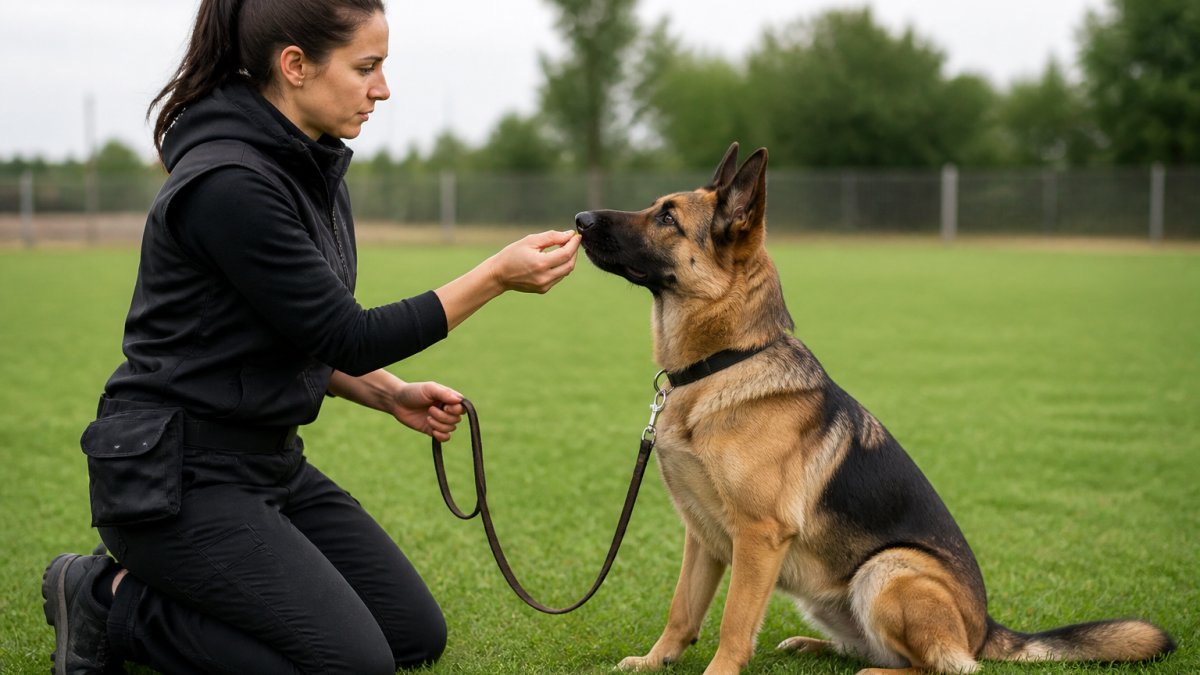
Look for clear communication, consistent structure, and a plan for building behavior rather than suppressing it. The American Veterinary Society of Animal Behavior position on humane training emphasizes reward-based methods as the foundation for lasting behavior change.
Balanced Training vs. Force-Free Approaches
Balanced training combines rewards with consequences, while force-free training relies entirely on reinforcement. Neither label guarantees quality. What matters is whether the trainer explains why a method works, adapts to your individual dog, and avoids techniques that cause fear or pain. Ask directly: “What happens when my dog gets it wrong?” A good answer describes redirecting and rewarding the correct behavior, not punishing the mistake.
Step 3: Check Dog Trainer Certification and Experience
Dog trainer certification is not legally required in most states, which means anyone can print a business card and call themselves a trainer. That is exactly why you need to verify credentials yourself, and why you should know which credentials actually exist before you start asking.
Credentials You Will Commonly See
Most professional certifications in the United States come from a small set of independent bodies. You do not need to memorize them, but recognizing the names helps you ask sharper questions.
- CPDT-KA (Certified Professional Dog Trainer – Knowledge Assessed), issued by the Certification Council for Professional Dog Trainers (CCPDT). Requires a set number of hands-on training hours, a proctored exam, and continuing education to renew.
- KPA-CTP (Karen Pryor Academy Certified Training Partner), a structured program with coursework, mentoring, and an assessment.
- CBCC-KA (Certified Behavior Consultant Canine – Knowledge Assessed), also from CCPDT, aimed at consultants handling more serious behavior cases.
- IAABC credentials (CDBC, CCBC, and related), issued by the International Association of Animal Behavior Consultants, with separate tracks for dogs, cats, and other species.
A trainer may also hold a certificate from a school or an online course. Those are not the same as an independent certification, and the difference matters: independent bodies require supervised hours and a proctored exam, while some online certificates require only a payment and a quiz.
How to Verify a Credential in Five Minutes
- Ask for the exact credential name and the issuing body, not just “certified.”
- Look up the trainer in that body’s public directory. Most maintain a searchable list of current certificants.
- Check the expiration date. Certifications lapse if continuing education is not completed.
- Ask how many hours of supervised, hands-on instruction the credential required.
- Ask what happens if the trainer’s methods are challenged, a credentialed trainer should be able to point to a code of ethics they are bound by.
Experience Matters as Much as the Badge
A common mistake is trusting a certification badge without asking about practical experience. A trainer certified last month may have less real-world judgment than someone who has worked with hundreds of reactive dogs over a decade. Weight both.
Ask species- and issue-specific questions:
- How many dogs with my dog’s exact issue have you worked with in the past year?
- What percentage of those cases improved, and how did you measure it?
- Have you ever referred a client to a veterinary behaviorist? (A trainer who never refers is a red flag for cases that need medical input.)
- Can I speak with two past clients who had a similar case?
A credential tells you the trainer met an outside standard. Experience tells you they can apply it to your dog. Ask for both, and verify the credential in the issuing body’s public directory before you book.
Step 4: Compare Training Options: Private Dog Training, Classes, and Board and Train
Private dog training, group classes, and board and train programs each solve different problems. Choosing the wrong format wastes time and money.
| Option | Best For | Typical Format | Main Trade-Off |
|---|---|---|---|
| Group classes | Puppies, basic manners | Weekly, 45-60 minutes | Less individual attention |
| Private lessons | Specific behavior goals | One-on-one, flexible scheduling | Higher per-session cost |
| In-home training | Leash pulling, door manners | Trainer comes to you | Limited to your home environment |
| Board and train | Intensive behavior change | Dog stays with trainer | Time away from home |
In-person training at your home reveals problems a training facility never sees. On-location training in parks or busy streets builds reliability around real distractions. Online training works for foundation knowledge but cannot replicate real-world proofing.
What Board and Train Dog Training Offers
Board and train dog training immerses your dog in a structured environment for days or weeks, with training happening throughout the day rather than in one weekly session. This format suits owners who need faster results or who have schedules that make consistent practice difficult. The trade-off is that you must learn to maintain the trainer’s cues and structure once your dog comes home, or the progress fades.
Step 5: Understand Pricing, Packages, and Program Duration
Pricing for dog training varies widely by format, program length, and the trainer’s experience. Group classes cost the least per session, private lessons sit in the middle, and board and train programs cost the most because they include daily care alongside instruction. What most providers do not explain is what actually drives those numbers, or how to tell whether a package is priced fairly.
What Drives the Price
Five factors explain nearly every quote you will receive:
- Format, group, private, in-home, or board and train.
- Contact hours, total time the trainer spends with your dog, not calendar weeks.
- Trainer seniority, a certified behavior consultant with a decade of casework charges more than an entry-level trainer.
- Travel, in-home and on-location sessions often include a mileage or travel-time component.
- Overhead, facility, insurance, and staff costs are baked into every rate.
Questions That Reveal the Real Cost
A quoted price is not the same as the cost of solving your problem. Ask:
- Is the price per session, per package, or per program?
- How many contact hours are included, and how long is each session?
- What happens if my dog needs more sessions than the package includes, is there a re-enrollment rate?
- Are there add-ons (e-collar rental, equipment, follow-up virtual sessions) that are not in the quote?
What a Well-Built Package Includes
A package worth paying for typically bundles four things: an initial assessment, a defined number of sessions, written homework or a training plan you can follow between sessions, and a follow-up check-in after the program ends. If any of those are missing, the package is thinner than it looks.
Matching Duration to the Goal
Program length should track the behavior, not a sales calendar:
- Puppy socialization and foundation manners, typically several weeks of weekly sessions, with daily practice at home.
- Basic obedience (sit, stay, down, recall, loose-leash walking), often several weeks to a few months, depending on the dog’s age and your consistency.
- Reactivity, fear, or aggression, commonly months of work, sometimes with a veterinary behaviorist involved.
- Board and train, usually measured in days to a few weeks of immersion, followed by owner handoff sessions.
How to Compare Two Quotes Side by Side
Divide total price by total contact hours to get a per-hour figure, then adjust for what is included. A cheaper package with no homework, no follow-up, and no assessment is often more expensive per solved problem than a higher-priced package that includes all three. Ask each provider to put the scope in writing, session count, duration, deliverables, and follow-up, so you are comparing like for like.
Beware of any trainer who quotes a price without first meeting your dog or asking about the behavior. A quote given blind is a sales tactic, not an assessment. The same goes for a guarantee of results: behavior change depends on the dog, the environment, and your follow-through, and no ethical trainer promises a fixed outcome before evaluating the case.
Step 6: What to Expect Before, During, and After Training
Before training starts, expect an assessment. A good trainer evaluates your dog’s temperament, your handling skills, and your home environment before recommending a program.
During training, you should receive regular updates, especially in board and train programs where your dog is away from home.
After training, the real work begins. Maintenance sessions, clear homework, and follow-up support determine whether the behavior sticks.
Step 7: Questions to Ask and Warning Signs to Avoid
Bring a written list to every consultation. Ask about methods, credentials, program duration, follow-up support, and what happens if your dog does not progress as expected.
Red flags to watch for:
- A trainer who guarantees results without evaluating your dog
- Refusal to let you observe a session
- No written contract or program outline
- Pressure to decide on the spot
- Inability to explain why a method works
At K9 Revolution, our Board & Train program in Westminster teaches 15 commands, including kennel manners, meet and greet protocols, and leash behavior, with round-the-clock care in a structured environment. We build a plan around your dog’s personality and learning style, then support you long after the program ends.
Frequently Asked Questions
How do I choose a professional dog trainer near me?
Start by defining your dog’s specific behavior goals, then verify the trainer’s certification and experience with similar dogs. Ask about their dog training methods, request client reviews or before-and-after videos, and confirm they offer follow-up support. Schedule a consultation to see how they interact with your dog. A trainer who explains their approach clearly and welcomes your questions is usually a better fit than one who rushes you toward a package.
Is private dog training or group class better for my dog?
Private dog training suits dogs with reactivity, fear, or aggression because the trainer can focus entirely on your dog without the distraction of other dogs. Group classes work well for puppies and social dogs that need basic commands like sit, stay, down, recall, and heel in a controlled setting. Many owners combine both. If your dog has had incidents with other dogs, start with private lessons and transition to group work once behavior improves.
How long does professional dog training take?
Program duration varies by training type and your dog’s behavior goals. Board and train programs typically run several weeks because the dog lives with the trainer for immersive learning. Private lessons often span four to eight sessions spread over a month or two. Puppy training may take longer since young dogs have shorter attention spans. Ask each trainer for a realistic timeline and what progress looks like at the halfway point.
What should I ask a dog trainer before booking?
Ask about their certification, how many years they have trained dogs with your specific issue, what dog training methods they use, and whether they offer follow-up support after the program ends. Request pricing details, program duration, and what happens if your dog does not progress as expected. Also ask for client references or video proof of results. A reputable trainer answers these questions directly and never pressures you to commit on the spot.