
Last Updated: October 30, 2026
Quick Summary
Dog boarding is an overnight stay at a professional facility that houses, feeds, and supervises your dog while you are away. Most dogs settle in within the first day, and a typical day includes meals, bathroom breaks, supervised play, and rest.
- Prepare vaccination records, medication lists, and familiar items before the first stay.
- Practice short separations at home, starting with 30 minutes and building up to a few hours.
- Ask for the daily schedule in writing and how staff adjust it for puppies, seniors, and anxious dogs.
- Request a written estimate that lists the base rate, add-ons, taxes, and any deposit.
- Compare boarding with pet sitting based on your dog’s temperament, health, and the length of your trip.
Table of Contents
- What Dog Boarding Is and How It Works
- Preparing Your Dog for a First Time Boarding Stay
- Check-In Day: What to Expect at the Facility
- A Realistic Hour-by-Hour Dog Boarding Daily Routine
- Dog Boarding vs. Pet Sitting: Which Fits Your Dog
- What Boarding Costs and What Fees Usually Cover
- Dog Boarding Checklist and Facility Inspection Questions
- Booking Your Dog’s First Stay With K9 Revolution
- Frequently Asked Questions
Dog boarding means your dog stays overnight at a facility while you are away, and many owners only learn what it is really like after the first drop-off. This guide walks you through a typical stay, from preparation to pickup, so you know what to expect. Dog boarding is a service where a professional facility houses your dog for one or more nights, feeds and exercises it, and supervises it around the clock.
What Dog Boarding Is and How It Works
Dog boarding is an overnight stay at a facility that cares for dogs when their owners cannot. Most facilities offer kennels, crates, or private suites, along with meals, bathroom breaks, supervised play, and staff checks through the night.
A typical stay follows a simple pattern:
- You drop off your dog and sign a stay agreement
- Staff review feeding, medication, and health records
- Your dog gets a routine of meals, walks, and rest
- You pick up your dog at the agreed time
Some facilities also offer training or daycare, so ask which services are included before booking.
Preparing Your Dog for a First Time Boarding Stay
Preparation makes the first stay much smoother. Start a few weeks before your trip rather than the night before.
Gather these items:
- Vaccination records, current as the facility requires
- A list of medications, with dosage and schedule
- Food in its original bag, so staff can match the diet
- Familiar items such as a bed, blanket, or toy
Then practice short separations at home. Leave your dog alone for 30 minutes, then an hour, then a few hours. This helps your dog learn that your return is predictable. Dogs that handle short absences well often settle in faster at a boarding facility.
Check-In Day: What to Expect at the Facility
Be honest about any habits, such as guarding food, fear of other dogs, or separation anxiety.
Your dog may seem uneasy at first. That is normal, and most dogs settle within the first day.
A Realistic Hour-by-Hour Dog Boarding Daily Routine
A schedule on paper tells you when meals and breaks happen. What owners actually want to know is how the day feels to the dog and how the facility adjusts when a dog does not fit the standard routine. Here is a realistic day, with the variations that matter.
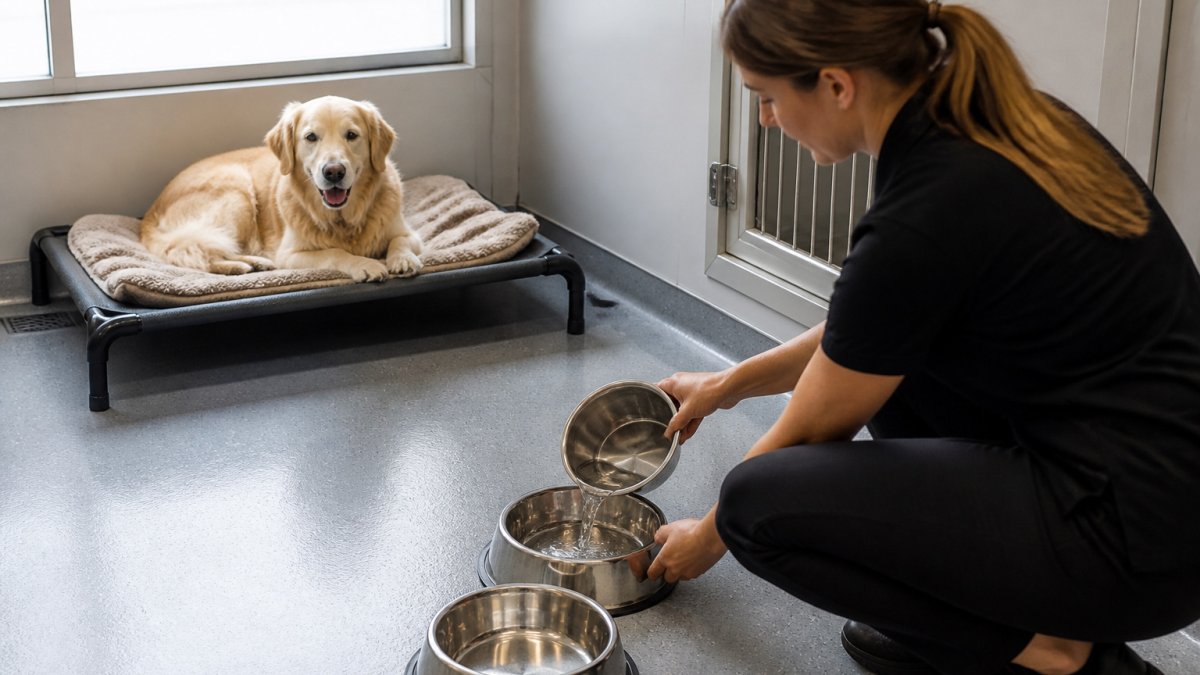
A typical day
- 6:00 to 8:00 AM: Staff do a visual check of every dog, offer a bathroom break, and serve breakfast. Dogs that eat quickly are let out again; dogs that are nervous about food are given quiet time and offered food again later.
- 9:00 to 11:00 AM: Supervised play or a walk, matched by size, energy, and temperament. A high-drive young dog may get a structured play session; an older dog may get a slow sniff walk.
- 12:00 to 2:00 PM: Rest in the kennel or suite with fresh water. Rest is not optional, it is when most dogs decompress, and it reduces over-arousal that leads to scrapes and squabbles.
- 3:00 to 5:00 PM: Second exercise session and bathroom break, often the longest outdoor period of the day.
- 6:00 to 8:00 PM: Dinner, a final outing, and a calm-down period before lights out.
- Overnight: Periodic checks, with bathroom breaks for dogs that need them.
How the routine changes for different dogs
- Puppies need more frequent bathroom breaks, shorter play sessions, and enforced nap time. Ask whether the facility separates puppies from adult play groups.
- Seniors often do better with shorter, more frequent outings, softer bedding, and help getting up. Ask whether staff can carry or support a dog that is unsteady.
- Dogs with medical needs may need medication at set times, which can shift the whole schedule. Confirm that medication timing is built into the day, not squeezed in when staff have a gap.
- Anxious or reactive dogs may need solo play, visual barriers between runs, or a quieter area away from the main kennel. A good facility will tell you honestly whether it can meet that need.
What to ask about the routine
Ask to see the written daily schedule and ask how many dogs one staff member handles during play. Ask what happens on rainy or extreme-heat days when outdoor time is limited. And ask how the facility logs what your dog did each day, many now send a daily report card with meals, bathroom habits, and activity, which is the fastest way to spot a dog that is not settling in.
A routine is only useful if it bends. The best signal of quality is not the schedule itself but how specifically staff can describe the adjustments they make for puppies, seniors, and anxious dogs.
The daily routine changes depending on the dog, and the article outlines how a typical day is structured.
| Time | What happens |
|---|---|
| 6:00 to 8:00 AM | Visual check, bathroom break, breakfast |
| 9:00 to 11:00 AM | Supervised play or walk, matched by size and energy |
| 12:00 to 2:00 PM | Rest in kennel or suite with fresh water |
| 3:00 to 5:00 PM | Second exercise session and bathroom break |
| 6:00 to 8:00 PM | Dinner, final outing, calm-down period |
| Overnight | Periodic checks, bathroom breaks as needed |
Dog Boarding vs. Pet Sitting: Which Fits Your Dog
Dog boarding and pet sitting both care for your dog while you travel, but they suit different needs.
Boarding works best when:
- Your dog enjoys social time with other dogs
- You want round-the-clock supervision
- You need a structured, predictable routine
Pet sitting works best when:
- Your dog is anxious in unfamiliar places
- Your dog needs one-on-one attention or medication at set times
- Your dog stays healthier at home in familiar surroundings
Neither option fits every dog. Consider temperament, health, and your travel length when you decide.
What Boarding Costs and What Fees Usually Cover
Pricing is one of the least transparent parts of dog boarding, and facility quotes often differ in what they include. A useful way to plan is to separate the base rate from the add-ons and the policies that can change your total.
What drives the base nightly rate
- Accommodation type. A standard kennel run, a crate-free suite, and a private room with a webcam are priced differently.
- Length of stay. Many facilities discount stays of a week or more and charge a higher rate during holidays and peak travel periods.
- Staffing model. Facilities with overnight staff on site generally charge more than those with on-call coverage.
- Included services. Some rates bundle a daily walk or play session; others charge per activity.
Common add-on fees to ask about
- Medication administration, especially injections or multiple daily doses
- Extra one-on-one walks or play sessions
- Special feeding (raw diets, home-cooked meals, or food the facility supplies)
- Bathing or grooming before pickup
- Late pickup or early drop-off outside standard hours
- Holiday surcharges
Policies that change the total
Ask whether the facility requires a deposit to hold a reservation, how much notice is needed to cancel without a fee, and whether you pay for the full stay if you pick up early. Get the cancellation and early-pickup policy in writing before you pay. If payment is a concern, you can review flexible financing options for your dog’s training.
How to compare quotes fairly
Ask each facility for a written estimate for your exact dates that lists the base rate, every add-on you expect to use, taxes, and any deposit. A lower nightly rate with several add-ons can cost more than a higher all-inclusive rate. Confirm what happens if your dog needs veterinary care during the stay and whether that cost is billed to you separately.
Ask for the estimate by email so you can compare facilities line by line. Verbal quotes often leave out medication fees and holiday surcharges.
For current pricing and what our Board & Train programs include, contact K9 REVOLUTION directly.
Dog Boarding Checklist and Facility Inspection Questions
Use this checklist when you visit a facility:
- Are the areas clean and well ventilated?
- Is fresh water available at all times?
- How many staff members are on duty overnight?
- How are dogs separated during play?
- What is the process for medical emergencies?
- Are vaccination requirements clearly listed?
- Can I see the daily routine in writing?
Trust your instincts. If staff seem rushed or evasive, look elsewhere.
Booking Your Dog’s First Stay With K9 Revolution
K9 REVOLUTION offers structured Board & Train programs with round-the-clock care in a professional setting. Our trainers work on 15 commands, including kennel manners, meet and greet protocols, and leash behavior. Book your free consultation today to discuss your dog’s needs and find out whether our program is the right fit.
Frequently Asked Questions
Is it hard on dogs to be boarded?
Most dogs adjust within a few days, though some take longer, especially first-time boarders or dogs prone to separation anxiety. Signs of stress include reduced appetite, restlessness, or excessive barking. A good facility will monitor these signs, keep a consistent routine, and communicate with owners if concerns arise. Visiting the facility beforehand and preparing your dog with familiar items can ease the transition noticeably.
What should I bring when boarding my dog?
Bring current vaccination and health records, any medication in its original labeled container with clear dosing instructions, and your dog’s regular food so digestion stays stable. Familiar items such as a bed, blanket, or toy help dogs settle into a new space. Label everything with your dog’s name. Confirm the facility’s specific packing requirements when you book, since rules on food, toys, and bedding vary.
How long does it take dogs to adjust to boarding?
Adjustment time varies by dog. Many settle within the first two to three days as they learn the routine, while some need up to a week. Dogs that have boarded before usually adjust faster. Keeping your dog’s meals, walks, and rest times consistent before the stay makes the transition smoother and gives staff a clear baseline for spotting unusual behavior.
Do I need to prepare my dog before boarding?
Yes. Practice short separations at home, introduce a crate or bed you plan to send along, and confirm vaccinations are up to date well before your stay. Ask the facility about its intake requirements and whether it offers a trial day. Preparing your dog reduces stress on both of you and helps staff identify any issues early.
