
Last Updated: October 23, 2026
Quick Summary
Task-based skills communication builds reliable behavior through real-world practice and repetition across varied contexts. Consistency comes from practicing commands at home, in neighborhoods, and public spaces with the same cues and handlers, creating automatic responses rather than context-dependent compliance.
- Foundation commands like sit, down, stay, and come must be reliable before introducing off-leash training.
- Dogs need practice in multiple environments: home, neighborhood, parks, and public spaces to develop genuine reliability.
- Measurable outcomes include response time under one second, 95%+ reliability across trials, and generalization to new contexts.
- All household members must use identical commands, hand signals, and reward timing to prevent conflicting information.
- Off-leash reliability requires systematic progression built on solid foundational skills, not rushed advancement.
Table of Contents
- What Task-Based Skills Mean for Consistent Communication
- Real-World Obedience Training: Building Skills That Stick
- Dog Communication Cues and Commands: The Foundation
- Dog Training in Everyday Situations: From Home to Public
- Off-Leash Reliability Training: Advanced Task Progression
- Assessment and Measurable Outcomes: Tracking Progress
- Maintaining Consistency Across Settings and Partners
- Frequently Asked Questions
What Task-Based Skills Mean for Consistent Communication
Task-based skills communication builds reliable behavior through real-world practice and repetition. At K9 REVOLUTION, dogs learn commands through repeated interactions that mirror the situations where you need them to respond.
The core principle: consistency comes from practice in varied contexts. A command mastered only in your living room hasn’t truly developed. Real learning happens when the behavior works reliably at home, in public, during distractions, and across different handlers.
Task-based skills differ from memorized commands. A dog that sits on cue in a quiet room has learned a single task.
Each task builds on previous ones. Your dog doesn’t jump straight to off-leash reliability; foundational commands establish focus and responsiveness, which then support more complex behaviors in distracting environments. This progression ensures lasting change rather than temporary compliance.
Real-World Obedience Training: Building Skills That Stick
Real-world obedience training moves beyond the training room into the messy, unpredictable situations where your dog actually lives.
The issue isn’t that the dog doesn’t understand the command. It’s that the dog hasn’t learned to execute it reliably across settings, people, and distraction levels. Real-world obedience training closes this gap by practicing commands where they matter most.
At K9 REVOLUTION, our Board & Train program emphasizes real-world application from day one. Repetition builds neural pathways that make behavior automatic rather than situational (Neural bases of automaticity).
Your dog’s motivation also changes by environment. In your living room, a treat might be enough; at a dog park with dozens of distractions, that same treat competes with far more interesting stimuli.
Dog Communication Cues and Commands: The Foundation
Understanding Verbal and Nonverbal Signals
Dogs communicate through verbal cues, body language, and environmental context (pubmed.ncbi.nlm.nih.gov). Your dog’s ability to read these signals determines how reliably they follow commands in real situations.
Verbal commands are only part of the equation. Dogs also read your body position, facial expression, tone, and energy level. A dog trained only to the word “sit” might miss the command if you’re facing away or your tone changes.
Nonverbal signals often carry more weight than words. Your dog might respond instantly to a hand gesture for “down” but ignore the verbal command if your body language contradicts it.
This explains why some dogs respond perfectly at home but struggle in new environments: they’ve learned specific cues in familiar settings but lack flexibility to recognize variations. Training both verbal and nonverbal communication builds more adaptable, reliable responses.
Building Clarity Through Repetition and Consistency
Consistency is the foundation of reliable communication. When everyone in your household uses the same word, hand signal, and timing, your dog builds a clear association between cue and behavior.
Repetition without consistency produces inconsistent results. Your dog might sit reliably for you but not your partner because the cues differ slightly.
Building clarity requires standardizing commands across all handlers and settings: the same word, hand signal, and reward delivery from everyone in your household.
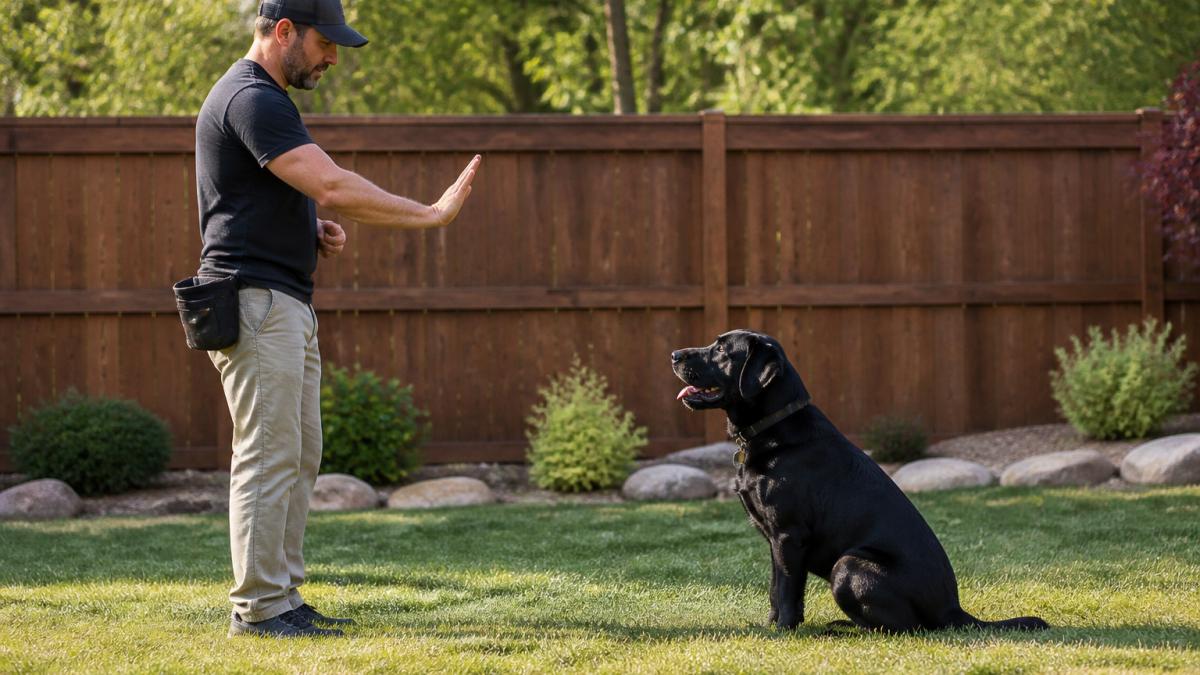
Timelines vary by dog and task complexity. Simple commands like sit might take weeks of consistent practice; reliable off-leash recall might take months.
Dog Training in Everyday Situations: From Home to Public
Training confined to a facility doesn’t transfer reliably to real life.
Home training establishes the foundation: basic commands in a familiar, low-distraction environment where your dog feels safe and confident. But home training alone doesn’t create reliable communication, it creates context-dependent compliance.
Neighborhood training introduces mild distractions: other dogs, people, vehicles, and environmental changes. Your dog learns to maintain focus even when interesting things happen nearby.
Public space training goes further. Parks, pet stores, and busy streets present far more distractions and unpredictability. A dog reliable in the neighborhood might struggle at a crowded park.
The progression from home to public isn’t linear. You don’t train at home for a month, then the neighborhood, then public spaces.
Off-Leash Reliability Training: Advanced Task Progression
Off-leash reliability training is the advanced stage of task-based skills development. Your dog responds consistently regardless of distraction, distance, or environmental novelty. This is where true communication happens: your dog chooses to respond even when not physically tethered to you.
Off-leash reliability doesn’t happen quickly or by accident. It requires systematic progression built on solid foundational skills. A dog without reliable on-leash obedience won’t suddenly become reliable off-leash; off-leash training extends and reinforces skills already developed.
Step 1: Foundation Commands in Low-Distraction Settings
Foundation commands establish the core behaviors your dog needs for off-leash work: sit, down, stay, come, and heel. These commands must be reliable before you introduce the complexity of an off-leash environment.
At this stage, your dog practices in controlled settings with minimal distractions to build automatic, consistent responses. Your dog should sit instantly when cued, hold a down-stay for extended periods, and return reliably when called. These aren’t perfect yet, just established enough to build on.
Training involves short, frequent sessions with clear rewards and immediate feedback. Your dog learns the exact behavior that produces a reward, and it becomes more reliable with each repetition. Consistency across handlers remains critical: everyone uses the same cues and reward system.
Step 2: Introducing Distractions and Duration
Once foundation commands are solid, you introduce distractions gradually. Your dog practices sit with another dog nearby, down-stay while people walk past, and come when mildly interesting things are happening in the environment.
Duration also increases. Your dog learns to hold a sit-stay or down-stay for longer periods, building the impulse control off-leash reliability requires. A dog that can only hold a down-stay for 30 seconds lacks the self-control to stay put off-leash and unsupervised.
Distractions are introduced systematically, not randomly: start mild in a familiar environment, then gradually increase distraction or novelty. This prevents overwhelm and builds confidence alongside skill.
Step 3: Real-World Environments and Off-Leash Freedom
The final stage moves your dog into real-world environments with increasing freedom: parks, hiking trails, around other dogs, and situations that mirror how you actually want to use off-leash reliability.
At this level, responses must be automatic and reliable under genuine distraction, faster and more consistent than your dog’s inclination to chase, play, or investigate. That reliability takes time and consistent practice, but it’s what allows genuine freedom while remaining under your control.
Off-leash training also requires understanding your dog’s temperament and learning style. Some dogs are naturally responsive and progress quickly; others need more repetition.
Assessment and Measurable Outcomes: Tracking Progress
Progress in task-based skills communication should be measurable and observable. Without clear assessment, it’s hard to know whether your dog is developing reliable communication or just performing better in specific situations.
Measurable outcomes include response time, reliability percentage, and generalization across contexts. Ideally, sit happens within one second of the cue.
Generalization across contexts is perhaps the most important measure. Your dog should respond reliably whether you’re at home, at a park, on a hiking trail, or with a different handler.
Tracking these outcomes helps you identify where your dog needs more practice.
Assessment also helps you recognize when your dog is ready to progress to the next stage of training. Moving forward too quickly leads to frustration and regression.
Maintaining Consistency Across Settings and Partners
Consistency is the thread that ties all task-based skills development together. A dog can have perfect obedience in one context and terrible obedience in another if the training hasn’t been consistent across settings and handlers.
Maintaining consistency requires that everyone interacting with your dog uses the same commands, hand signals, reward timing, and behavioral expectations.
This consistency extends beyond your household. If your dog trains with one handler and then works with a different handler, the communication must remain clear.
Consistency also means recognizing that your dog’s behavior will regress if practice stops. A dog that reaches reliable off-leash communication won’t maintain that reliability without ongoing practice.
Developing task-based skills for consistent communication transforms your relationship with your dog. K9 REVOLUTION’s Board & Train program provides the structured environment and expert guidance to build these skills systematically, ensuring your dog develops the foundation for lifelong reliability and connection.
Frequently Asked Questions
How do task-based skills for consistent communication actually improve my dog’s behavior?
Task-based skills break communication into specific, achievable actions your dog practices repeatedly in different environments. This repetition builds neural pathways that make responses automatic and reliable. When your dog learns a command through multiple real-world tasks, not just in training sessions, the skill transfers to everyday situations. Consistent communication means your dog understands the same cue the same way, whether you’re at home, on a hike, or in a busy park.
What’s the difference between task-based learning and traditional obedience training?
Traditional obedience often focuses on isolated commands in controlled settings. Task-based learning embeds those commands into functional activities your dog performs daily. Instead of practicing ‘sit’ in a quiet room, task-based training uses ‘sit’ as part of real-world scenarios: sitting before meals, sitting when guests arrive, sitting before crossing the street. This approach builds stronger, more flexible communication because your dog learns the command serves a purpose in actual life.
How long does it take to develop task-based skills for consistent communication?
Timeline depends on your dog’s age, prior training, and how frequently you practice. Puppies and younger dogs often progress faster because they have fewer ingrained habits. Most dogs show noticeable improvement in 4-8 weeks of structured, consistent practice. However, true mastery, where skills transfer reliably across settings and distractions, typically requires 3-6 months of ongoing reinforcement. Consistency matters more than speed; sporadic practice extends timelines significantly.
Can task-based training work for dogs with behavioral issues like jumping or reactivity?
Yes. Task-based training is especially effective for behavioral challenges because it teaches your dog what to do instead of what not to do. For jumping, you build a task around sitting calmly when someone approaches. For reactivity, you create tasks that reward calm focus despite triggers. The structured, repetitive nature of task-based learning helps dogs with anxiety or impulse control issues because they learn predictable patterns and clear expectations in real-world contexts.
How do I maintain task-based skills once my dog comes home from a Board & Train program?
Consistency is critical. Use the same cues, hand signals, and reward patterns your trainer used. Practice the 15 commands and tasks in your daily routine, before meals, on walks, during play. Spend 10-15 minutes daily on reinforcement exercises. Follow-up support ensures you can troubleshoot when your dog regresses or encounters new distractions. Regular practice prevents skills from fading.
What makes task-based training different from other training methods I’ve tried?
Task-based training connects communication directly to your dog’s daily life, making skills functional and memorable. Instead of learning commands in isolation, your dog practices them as part of meaningful activities. This approach builds stronger neural associations and deeper understanding. When combined with structured, consistent practice in real-world situations, not just training sessions, task-based skills stick because they’re embedded in your dog’s routine, not disconnected from it.
How do I know if my dog is making real progress with task-based skills?
Progress shows up as reliable responses across different settings and distractions. Your dog responds to cues consistently at home, on walks, in parks, and around other people. You’ll notice fewer behavioral issues, better impulse control, and calmer responses to triggers. Measurable outcomes include the number of commands your dog reliably executes, how quickly they respond, and how well they perform in distracting environments. A formal assessment rubric tracks these metrics to ensure lasting improvement.
